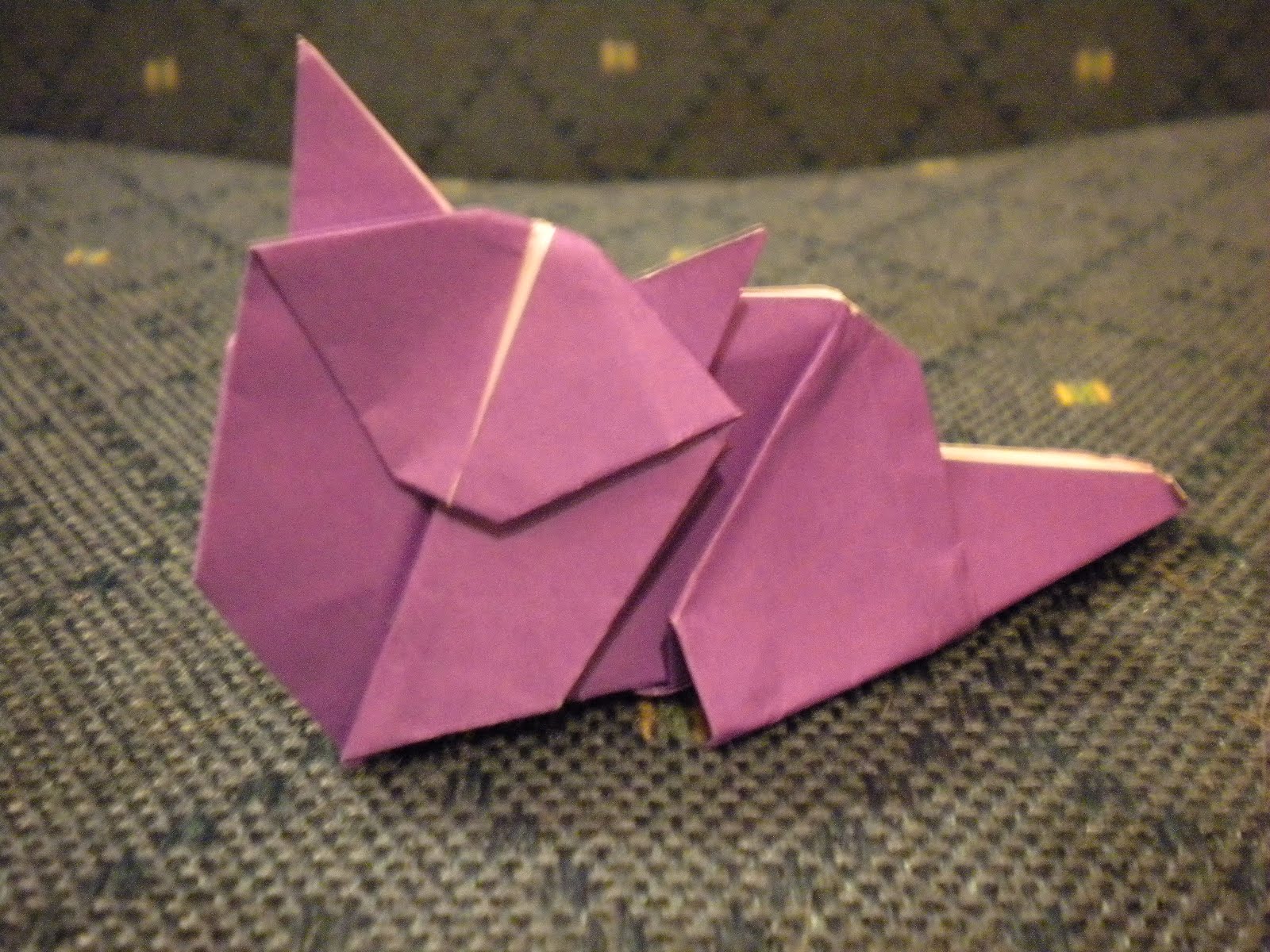
Being fond of cats, I tried these three (two, really) designs.
This cat I named Sierra. She was not made from any particular base, but by folding opposite edges of a piece of paper to the middle crease and then forming legs, tail, and finally head. Like most animals, she is uses "book" symmetry because you fold her in half down the middle to create her.
The design was published in the book "Teach Yourself Origami" by John Montroll.
This Leopard was created by virtually the same design as Sierra, but I made some adjustments to make him more Leopard-like. I reverse-folded the tips of the ears so they would be more rounded, and I crimp-folded the legs forward to give him the appearance of laying down. I also fixed the tail so it was thinner and curved more.
This Persian cat used a very different method. For one thing, she is not completely symmetrical, as her head is tilted to one side. She also does not have distinct legs, which make her more than an ornament than a creature that can move around.
The design was published in "Origami Omnibus" by Kunihiko Kasahara.
Origami for all!
Learn new designs and old in this appreciation of an ancient art!
Waterwheel by Fred Rohm
Sunday, October 21, 2012
Friday, October 19, 2012
Cranes and variations: Snowen and Fin
(I often like to name my origami models. I think it gives them a little bit more character, instead of just a piece of paper.)
Snowen was an original style derived from a traditional style. It is made from the bird base, which, being so simple, allows for a lot of creativity when it comes to details and finishing touches. Snowen's back had 2 sinks, one on top of the other, to create the concentric squares. His head and beak were formed from a couple reverse and crimp folds.
Detail of back:
Fin is the style of a "flying crane" in the book "Origami Omnibus" by Kunihiko Kasahara. This style folds a length of the diagonal over itself to create a smaller square, and then the crane is folded the traditional way. By putting more paper at the front of the wings and in the length of the tail, the crane takes on a very different shape, and indeed looks like it ought to be flying.
Snowen was an original style derived from a traditional style. It is made from the bird base, which, being so simple, allows for a lot of creativity when it comes to details and finishing touches. Snowen's back had 2 sinks, one on top of the other, to create the concentric squares. His head and beak were formed from a couple reverse and crimp folds.
Detail of back:
Fin is the style of a "flying crane" in the book "Origami Omnibus" by Kunihiko Kasahara. This style folds a length of the diagonal over itself to create a smaller square, and then the crane is folded the traditional way. By putting more paper at the front of the wings and in the length of the tail, the crane takes on a very different shape, and indeed looks like it ought to be flying.
Thursday, October 18, 2012
Welcome!
These photographs are of two of my favorite models. This dragon was designed by Kade Chan. This is an extremely difficult design, as many of the folds require three-dimensional intermediate steps. My first try on this model took an hour and a half. Here's the link to the tutorial by: Tadashi Mori This waterwheel was designed by Fred Rohm and published in "Teach Yourself Origami" by John Montroll by Dover Publications, Inc. in 1998. This model, while difficult, utilizes many squash folds and three-dimensional intermediate steps. These folds are repeated over an over for each corner, so the entire piece, once mastered, is quite easy to memorize.
Subscribe to:
Posts (Atom)